

The Breakthrough Year Is When Most Businesses Break
The danger isn't the slow year. The danger is the breakthrough year—the one where orders finally flood in, sales finally land, the thing you've been building quietly for years suddenly catches fire. That's when the cracks appear. Not because the business is failing. Because it's succeeding faster than the systems holding it together were ever designed to handle.
 Gloria Nnebedum
Success Breaks More Businesses Than Failure Ever Does
Most Businesses Don't Fail When Things Are Going Wrong. They Fail When Things Are Going Right. That's the part nobody warns you about. The danger isn't the slow year. The danger is the breakthrough year—the one where orders finally flood in, sales finally land, the thing you've been building quietly for years suddenly catches fire. That's when the cracks appear. Not because the business is failing. Because it's succeeding faster than the systems holding it together were ever designed to handle.
Adaeze didn't plan to build a skincare brand. She planned to sell a few products to people who trusted her skin.
Stage One: The Instagram Era
It started the way most Nigerian product businesses start. A close-up photo of a serum on a bathroom shelf. A few saves. Then a DM. Then ten. Then a hundred. Within eight months of her first post, Adaeze was packing orders from her bedroom every night, printing shipping labels at 11 PM, taking payments through bank transfer because that was the only option she'd set up. It worked. Barely, but it worked. She knew every customer by name. She remembered every order. Her "system" was a notes app and the credit alert sound on her phone. Then the waiting list hit three hundred people and she realized the bedroom wasn't going to hold it.
What she didn't realize yet: she was already building fragmentation into her foundation. One bank account. One transfer method. It seemed simple. But simple and scalable are different things. With Nomba from the start, those three hundred customers could have been managed through one system—payments, confirmations, reconciliation, all in one place. But she didn't know she'd need that yet. Nobody does at the bedroom stage.
Stage Two: The Physical Store and the POS That Changed Everything
She took a small space in a beauty arcade in Lekki. Put up a shelf. Got a POS terminal. The first week she processed more transactions in four days than she had in the previous month online. The POS felt like a superpower. For a while, it was. But the bank transfer customers didn't disappear. They layered on top of the POS customers. Now she had two streams of money coming in through two different channels, settling at different times, with no clean way to see the full picture at once.
Here's where the fragmentation starts to hurt. The POS provider gives her one dashboard. Her bank gives her another. The two don't talk to each other. Reconciling Tuesday's revenue meant logging into two separate systems, downloading two separate reports, cross-referencing her POS transactions with her bank statement with her DM receipts. Every week, something didn't add up. Not by much. But enough to be stressful. Enough to make her distrust her own numbers. She hired a part-time bookkeeper. The bookkeeper spent most of her time reconciling. Not analyzing. Not advising. Just matching figures that should have matched automatically.
With Nomba, the POS and the bank transfers would have lived in the same system. One login. One dashboard. One reconciliation process that happens automatically. The bookkeeper could have been analyzing margins instead of hunting for missing ₦15,000.
Stage Three: The Website, the Odd-Hour Orders, and the Problem With Success
A beauty editor featured Adaeze's vitamin C serum in a round-up. The website, which she'd built mostly as a credibility play, started converting at 2 AM. At 4 AM. At times when no bank transfer was going to get confirmed and no POS was going to be tapped. She needed a payment gateway. She set one up. Now there were three revenue channels, three settlement timelines, and a bookkeeper who had quietly started looking exhausted.
Three providers. Three logins. Three reconciliation processes. Three customer service numbers to call when something breaks. The POS provider doesn't know about the gateway transactions. The gateway doesn't know about the POS. The bank account catches everything eventually, but days later, in a format that doesn't match either system. Tuesday's revenue was no longer a number you could know on Tuesday. It was a puzzle you assembled by Thursday if you were lucky.
The odd-hour orders were wonderful and completely disorienting. She was making more money than she ever had. She also had less clarity about her cash position than at any point since she started. The success had outrun the system. More accurately, the systems—plural, scattered, unconnected—had become the problem.
Nomba was built for this exact moment. One platform handling POS, online payments, bank transfers. Every transaction, regardless of channel, flowing into the same dashboard. Real-time settlement. Instant reconciliation. The bookkeeper finally stopped hunting for discrepancies and started doing actual financial analysis—telling Adaeze what her numbers meant, not just what they were.
Stage Four: The International Buyers and the Infrastructure Question
Then came the message she hadn't expected. A buyer in the UK. Then one in Canada. Then a small beauty retailer in Atlanta who wanted to stock the serums in her store. Adaeze's payment setup had no answer for this. Her payment gateway didn't support international cards cleanly. Her bank charged ₦5,000 per international transfer plus a 3-day processing window. One international customer tried four times before the transaction went through and left a note in the order saying she almost didn't bother. Almost didn't bother. That sentence sat with Adaeze for a week.
Now she's looking at adding a fourth provider—someone who handles international payments properly. Which means a fourth login. A fourth settlement timeline. A fourth reconciliation nightmare. A fourth customer service line. Her bookkeeper is now spending 25 hours weekly just matching transactions across four systems before she can even begin to tell Adaeze if the business made money last week.
This is the trap. Every growth stage adds a new provider because the previous providers weren't built to scale with you. POS provider for in-store. Gateway for online. Another gateway for international. A separate service for payouts. By the time you're doing ₦50M monthly, you're stitching together five different companies' systems and wondering why you can't get a clear answer to "how much did we make yesterday?"
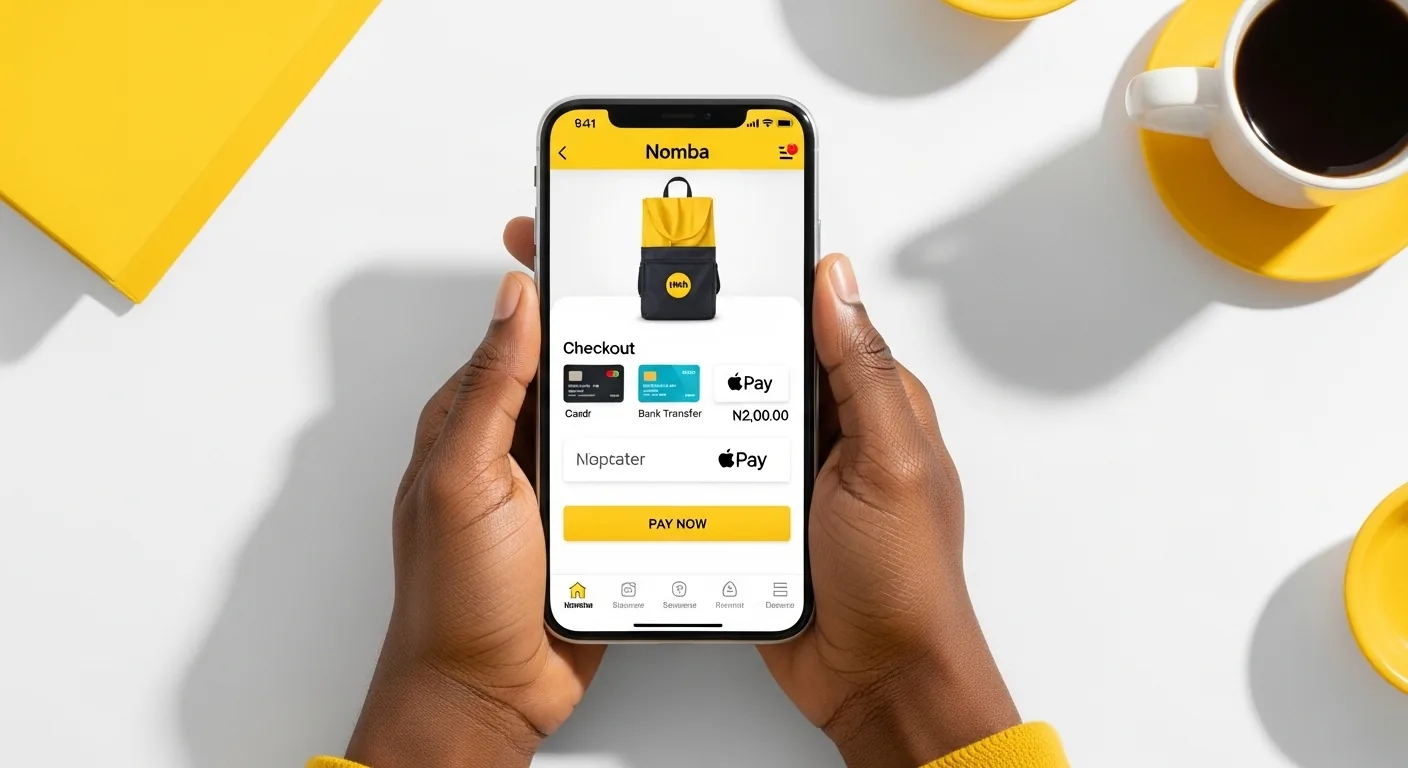
Nomba's checkout handled it in one flow. Local cards, international cards, bank transfers, Apple Pay, Google Pay—all processed through the same system Adaeze was already using for POS and online payments. The Atlanta retailer completed her order in under two minutes. The transaction appeared in the same dashboard as every other sale. Settled to the same account. No new provider. No new reconciliation process. Just growth, without the infrastructure fragmentation that usually comes with it.
Stage Five: Importing at Scale, and the Cost of Slow Money
Growth changed the raw material equation. What Adaeze once sourced locally in small batches, she now needed to import in bulk. The margins only made sense at volume. And volume meant large international transfers—sometimes moving the equivalent of several months' earlier revenue in a single wire. This is where slow money becomes an existential problem. A supplier in South Korea offering a 12% bulk discount for payment within 72 hours is not offering a discount. He is offering a test: Can your business move money fast enough to capture an opportunity when it appears?
Her bank's international transfer process: fill out forms, submit documentation, wait 3-5 days for compliance approval, pay ₦35,000 in fees, hope the exchange rate hasn't moved against you by the time it processes. She missed the 72-hour window twice. Lost ₦2.1M in bulk discounts she couldn't capture because her money moved too slowly.
She looked at adding another provider—a fintech specializing in international transfers. Faster processing, better rates. But now she's managing five financial relationships. Five dashboards. Five reconciliation streams. Her bookkeeper quit. The new one wants ₦200,000 monthly because the reconciliation workload has become a full-time job plus overtime.
Most businesses at this stage accept this as normal. You grow, you add providers, you hire people to manage the complexity. But complexity isn't a stage of business. It's a tax you're choosing to pay.
Nomba handled the international transfer from the same account that handled her POS transactions and online sales. Competitive FX rates. 24-hour settlement. The ₦18M payment to the Korean supplier left on Tuesday morning, arrived Wednesday. The 12% bulk discount was captured. The margin held. More importantly, Adaeze didn't add a fifth financial provider. She didn't hire a second bookkeeper. She just moved money when she needed to, through infrastructure that was already handling everything else.
What the Journey Actually Teaches You
Adaeze's business didn't fail when things were hard. It almost failed three times when things were going well. When the orders were more than the bedroom could hold. When the channels were more than the bookkeeper could manually track. When the international buyers were ready to spend money she couldn't receive cleanly. Every crack appeared at a moment of success. Every crack was the business telling her the same thing: the version of you that got here isn't the version of you that goes further.
But here's what took her longest to realize: the problem wasn't that she was growing. The problem was that growth kept requiring new providers. POS from one company. Online payments from another. International transfers from a third. Each one solving one problem while creating a bigger one—fragmentation. By the time she had five providers, she was spending more time managing financial infrastructure than building the actual business.
The founders who scale without breaking don't collect more tools. They start with infrastructure built to grow with them. One platform that handles in-store and online. Local and international. Naira and dollars. Transfers in and transfers out. Because the alternative isn't just inconvenient. It's expensive. It's slow. And at a certain scale, it's what kills momentum.
Nomba was built for ambitious businesses at every stage. Not because we think businesses should use one platform for everything. Because we've watched too many businesses like Adaeze's break under the weight of stitching together five providers who don't talk to each other. POS, payments, transfers, international settlements, working capital—it's one system. It scales with you. You don't outgrow it and go looking for the next provider. You just grow.
Ready to build without the fragmentation?
Nomba gives you everything in one place: POS for in-store, checkout for online, international transfers, multi-currency accounts, real-time reconciliation. One dashboard. One partner. Built for businesses that don't stop at one stage.
Because the danger isn't the slow year. It's the breakthrough year. And your infrastructure shouldn't be the thing that breaks when you succeed.